

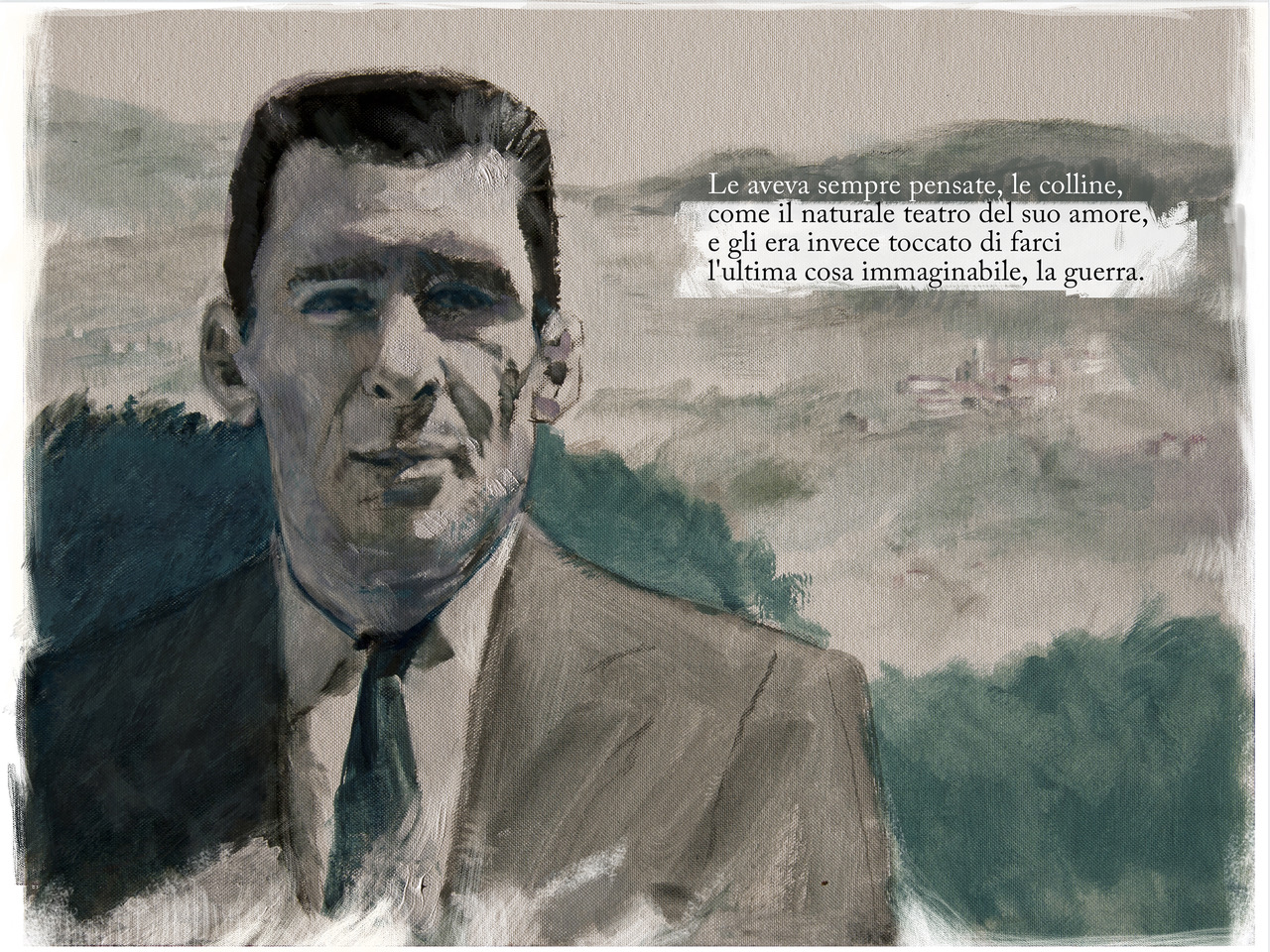

Beppe Fenoglio
Alba, 1° marzo 1922 – Torino, 18 febbraio 1963
Scrittore e traduttore, è una tra le voci più intense del secondo Novecento.
Nato ad Alba, ha fatto delle Langhe e della Resistenza il cuore delle sue opere. Iscrittosi a Lettere a Torino, dovette interrompere gli studi per la guerra: partecipò prima come ufficiale e, dopo l’8 settembre 1943, come partigiano nelle formazioni di Mauri, attive proprio nell’area delle Langhe.
Nel dopoguerra tornò ad Alba dove lavorò come corrispondente estero in un’azienda vinicola, mantenendo un rapporto quotidiano con quel paesaggio di colline e paesi che diventò nei suoi libri scena concreta e insieme misura morale delle scelte. Non a caso, oltre ad Alba, frequentò a lungo anche luoghi dell’Alta Langa come San Benedetto Belbo e Murazzano, entrati nei suoi “percorsi” letterari e nell’immaginario narrativo. Pubblicò tra l’altro I ventitré giorni della città di Alba (1952), La malora (1954) e Primavera di bellezza (1959); postume uscirono opere decisive come Una questione privata (1965) e Il partigiano Johnny (1968).

Beppe Fenoglio
Alba, March 1st, 1922 – Turin, February 18th, 1963
Beppe Fenoglio
Alba, March 1st, 1922 – Turin, February 18th, 1963
Beppe Fenoglio was a writer, a translator, and one of the most compelling voices of the second half of the 20th century. Born in Alba, he centered his works around the themes of Langhe territory and Resistance. He enrolled in the Department of Literature at the University of Turin but was forced to interrupt his studies due to the war. He first served as an officer and, after September 8th, 1943, he joined Mauri’s partisan units in the Langhe region.
After the war, he returned to Alba, where he worked as a foreign correspondent for a winery. He maintained a daily connection with the landscape of hills and villages that would become both a concrete setting and a moral yardstick for choices in his books. It is no coincidence that he also spent a great deal of time in Alta Langa places such as San Benedetto Belbo and Murazzano, which became part of his literary “journeys” and narrative imagination. His published works including I ventitré giorni della città di Alba (1952), La malora (1954) and Primavera di bellezza (1959). After his death, seminal works such as Una questione privata (1965) and Il partigiano Johnny (1968) were published.

Beppe Fenoglio
Alba, 1. März 1922 – Turin, 18. Februar 1963
Der Schriftsteller und Übersetzer Beppe Fenoglio zählt zu den bedeutendsten Stimmen der zweiten Hälfte des 20. Jahrhunderts. Der in Alba geborene Autor machte die Langhe und den Widerstand zum Mittelpunkt seines Schaffens. Er schrieb sich in Turin für ein Literaturstudium ein, musste dieses jedoch wegen des Krieges unterbrechen. Zunächst diente er als Offizier und nach dem 8. September 1943 als Partisan in den Formationen von Mauri, die in der Region Langhe aktiv waren.
Nach dem Krieg kehrte er nach Alba zurück und arbeitete als Auslandskorrespondent in einem Weingut, wodurch er einen täglichen Bezug zu jener Landschaft aus Hügeln und Dörfern pflegte, die in seinen Büchern zur konkreten Kulisse und zugleich zum moralischen Maßstab für Entscheidungen wurde. Es ist kein Zufall, dass er neben Alba auch Orte der Alta Langa wie San Benedetto Belbo und Murazzano frequentierte, die Eingang in seine literarischen „Wege” und seine erzählerische Vorstellungswelt fanden. Er veröffentlichte unter anderem I ventitré giorni della
città di Alba (1952), La malora (1954) und Primavera di bellezza (1959). Posthum erschienen weitere wichtige Werke wie Una questione privata (1965) und Il partigiano Johnny (1968).

Beppe Fenoglio
Alba, 1er mars 1922 – Turin, 18 février 1963
Beppe Fenoglio
Alba, 1er mars 1922 – Turin, 18 février 1963
Beppe Fenoglio est un écrivain et traducteur italien, l’une des figures les plus marquantes de la seconde moitié du XXème siècle. Originaire d’Alba, il a placé les Langhe et la Résistance au cœur de son œuvre. Inscrit en lettres à l’université de Turin, il a dû interrompre ses études à cause de la guerre : d’abord officier, puis partisan dans les formations de Mauri, actives précisément dans la région des Langhe, après le 8 septembre 1943.
Après la guerre, il est retourné à Alba, où il a travaillé comme correspondant étranger dans une entreprise viticole, entretenant un rapport quotidien avec le paysage de collines et de villages qui est devenu, dans ses livres, à la fois un décor concret et une référence morale pour ses choix. Ce n’est pas un hasard si, outre Alba, il a longtemps fréquenté des lieux de la Haute Langa, comme San Benedetto Belbo et Murazzano, qui ont figuré dans ses « parcours » littéraires et dans son imaginaire narratif. Il a notamment publié I ventitré giorni della città di Alba (1952), La malora (1954) et Primavera di bellezza (1959). Des œuvres décisives telles que Una questione privata (1965) et Il partigiano Johnny (1968) ont été publiées à titre posthume.